
What exactly is QHSE?
QHSE is the set of agreements and activities that make sure work is done safely, healthily, responsibly towards the environment and at the right quality. Think of assessing risks, reporting incidents, carrying out inspections, running audits and following up actions.
Many organisations work with standards such as ISO 9001 (quality), ISO 14001 (environment) and ISO 45001 (occupational health and safety), or with client requirements such as VCA. The aim is always the same: demonstrably control what you say you control.
A QHSE system is therefore not a folder of procedures, but a way of working: you record what you do, you check whether it is right and you improve what does not go well. Software supports that cycle, it does not replace people's attention.
What does a QHSE platform do?
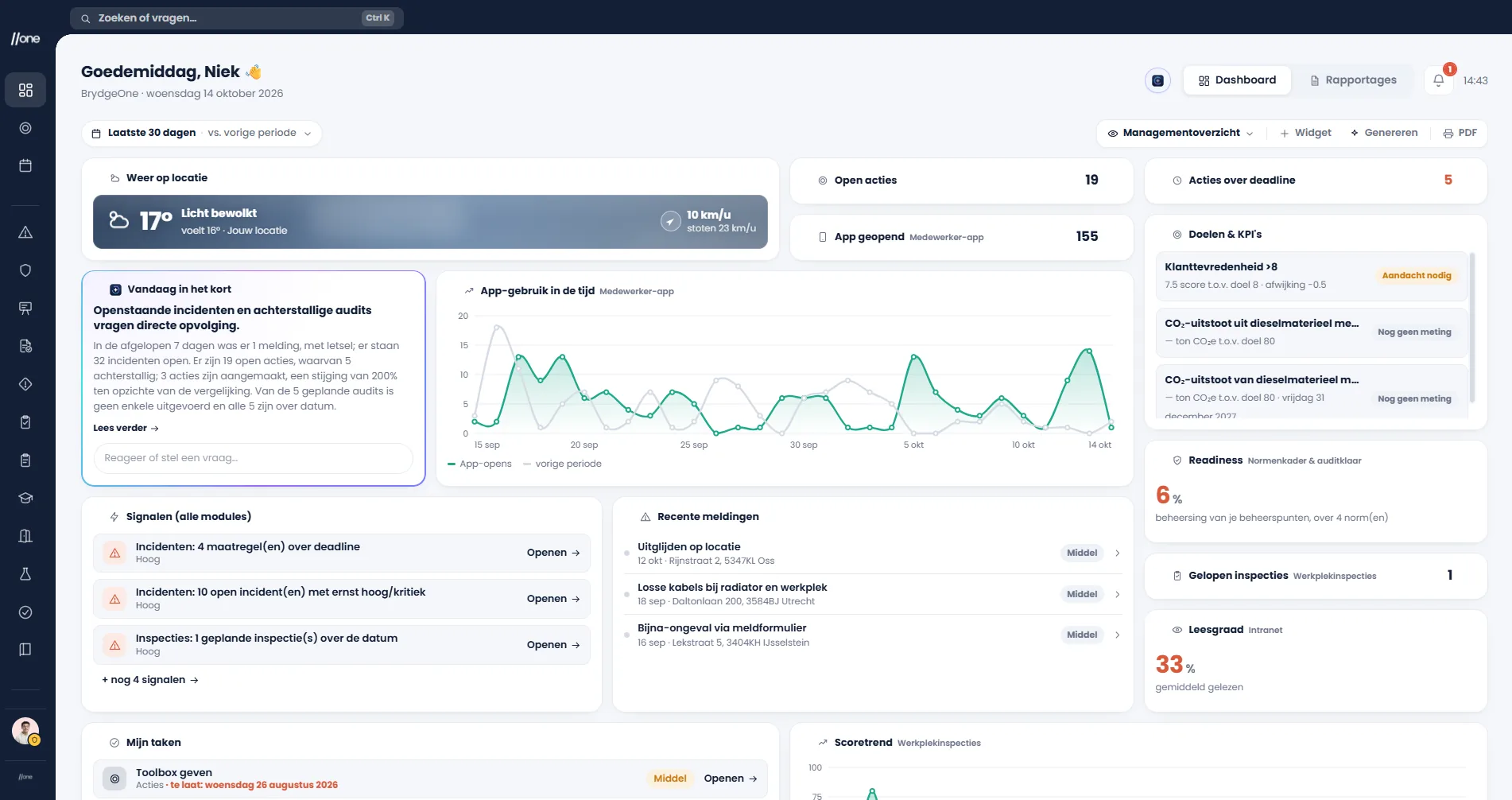
A QHSE platform is software that records, monitors and shows this work. Instead of separate spreadsheets, folders and emails you work in one system where everything connects: an incident leads to an action, an audit to a finding, a hazardous substance to a risk.
The biggest benefit is follow-up. Every report, finding or deviation gets an owner and a deadline, and one overview shows what is still open.
Which parts belong to it?
The parts differ per provider, but the core is much the same everywhere:
- Safety: incidents and reports, inspections, risk assessments, last minute risk analysis, toolbox talks and work permits
- Quality: quality reports, supplier evaluation, calibration and satisfaction
- Environment: environmental aspects, environmental reports and compliance obligations
- Management system: document control, audits, actions and CAPA, management review and standards framework
- Sustainability: energy, emissions and reporting
Choosing, part 1: structure and standards
Modular: choose a platform you can start small with and grow. You should not need everything at once, and a module should work on its own.
Standard-independent: if you work with ISO 9001 today and add ISO 45001 tomorrow, you do not want to enter everything again. A good platform records controls once and shows them under several standards.
Ask for each part whether it can be used on its own. An organisation that only wants to record incidents and actions should not have to pay for or set up a full management system.
Choosing, part 2: shop floor, AI and integrations
Shop floor and app: safety is not done at a desk. Check that employees can report, inspect and sign on a phone or tablet, also on site. The lower the threshold, the more reports you get.
AI: useful as help with summarising, asking questions about your own data or suggesting questions. Do ask who decides: the user should always be able to approve or change the result.
Integrations: check whether the platform connects to what you already use, such as HR systems or sign-in through your existing environment.
Choosing, part 3: pricing, data and security
Pricing model: check whether you pay for what you use or for a large package with many unused features. Also ask about costs for extra users, sites and support.
Data and security: ask where your data is stored, who can access it and how sign-in is secured, for example with two-step verification. Also ask what happens to your data if you leave.
Finally, ask how the platform handles different roles. An employee should only see what belongs to their work, while a QHSE manager needs the overview across all sites.
A practical example
Say a fitter sees a loose cable and reports it on his phone, with a photo. In a QHSE platform that report goes straight to the right person. That person turns it into an action with a deadline, possibly links a risk from the risk assessment and closes it with a note.
At the next audit you do not have to search. The report, photo, action and closure are together and traceable. That is exactly what sets a platform apart from separate lists.
Common mistakes when choosing
Some pitfalls come up again and again:
- Choosing on a feature list instead of on use: a long list does not help if nobody uses it
- Letting only the QHSE manager take part, while the shop floor needs the system every day
- Wanting to implement everything at once instead of starting small
- Skipping a trial or demo with your own scenarios
- Not asking how to get your data out again if you leave
How to approach it
Start with a short list of what hurts most right now, such as reports, inspections or audits. Ask providers to show those parts using your situation. Let a few people from the shop floor test along and see how quickly they can file a report.
Then pick a starting module, set owners and deadlines and expand step by step. That builds support before the system gets bigger.
BrydgeOne as a practical example
BrydgeOne is a QHSE platform with separate modules for safety, quality, environment, sustainability and management system, with an employee app for the shop floor. The standards framework manages ISO 9001, 14001 and 45001 in one register. Prices start from € 49 per month.
© 2026 BrydgeOne. General information, not legal or other professional advice. No rights can be derived from this article.