
 Management system4 min read
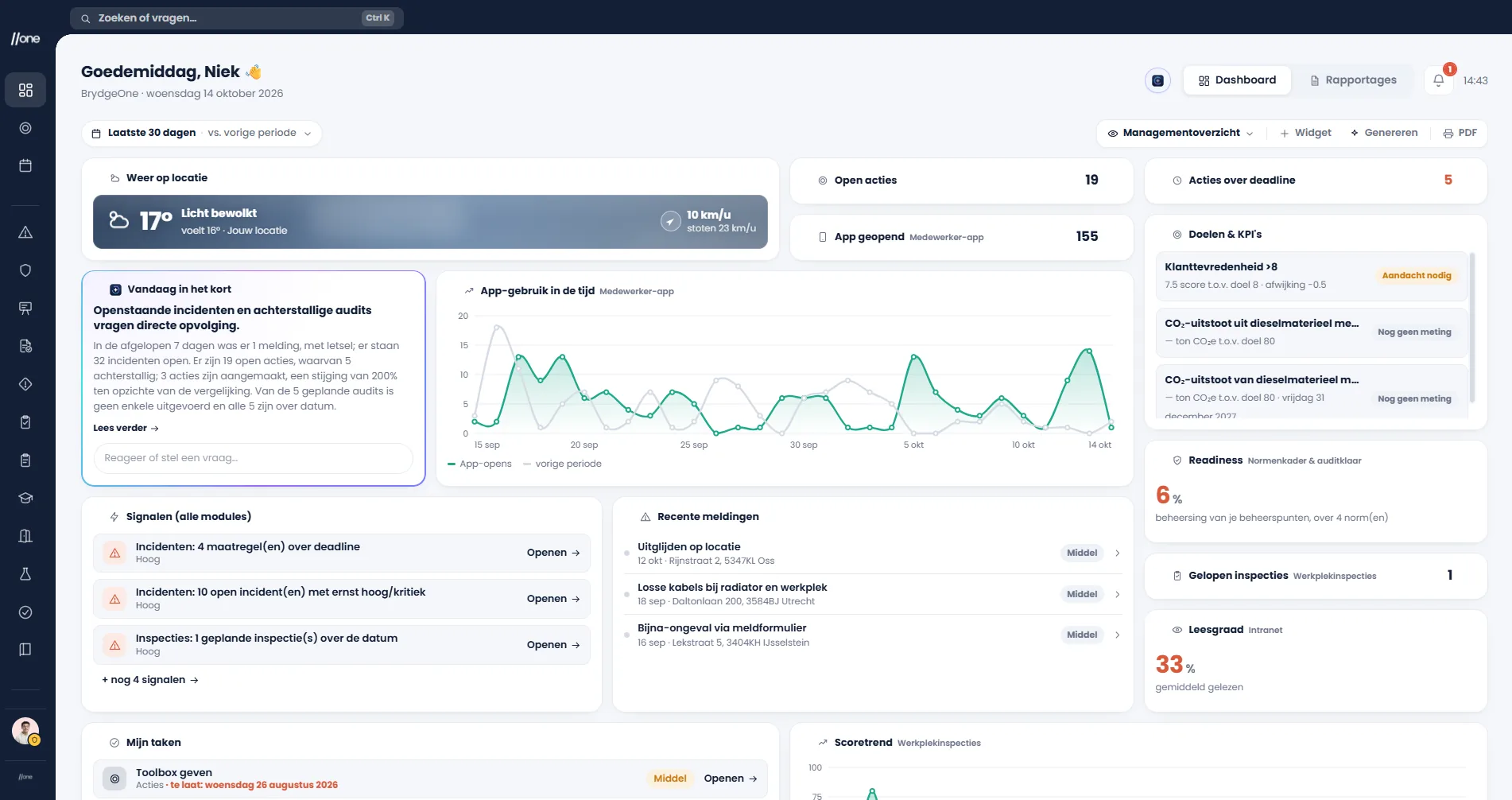
What is a QHSE platform and what should you look for when choosing one?
QHSE stands for Quality, Health, Safety and Environment. A QHSE platform brings the work on all four topics together in one environment. This article explains what such a platform does and what to look for when you choose one.
Read the guide Management system4 min readQHSE software or Excel: when should you switch?
Almost every QHSE system starts in Excel, and that is perfectly fine. Yet there comes a point where the spreadsheets cost more work than they save. This article helps you recognise that point.
Read the guide Quality4 min readCarrying out an internal audit: step-by-step plan and checklist
An internal audit tests whether your management system does what you agreed and whether it works. With a fixed plan it becomes a source of improvement rather than a paper exercise. This article walks through the seven steps, with a checklist.
Read the guide Safety5 min readImplementing ISO 45001: a step-by-step plan for safe and healthy work
ISO 45001 is the international standard for an occupational health and safety management system. It helps you prevent accidents and work-related ill health rather than only recording them afterwards. This step-by-step plan shows how to put the standard into practice, from the first baseline to certification.
Read the guide Quality4 min readIntroducing ISO 9001: how to set up a quality management system
ISO 9001 is the most widely known standard for quality management. It helps you deliver consistently what customers expect and keep getting better. Here is how to set up a system that fits your organisation instead of a pile of documents.
Read the guide Environment4 min readISO 14001: how to build an environmental management system
ISO 14001 helps you control and gradually reduce the environmental impact of your organisation. The standard revolves around insight into your environmental aspects, compliance with obligations and demonstrable improvement. Here is how to build the system.
Read the guide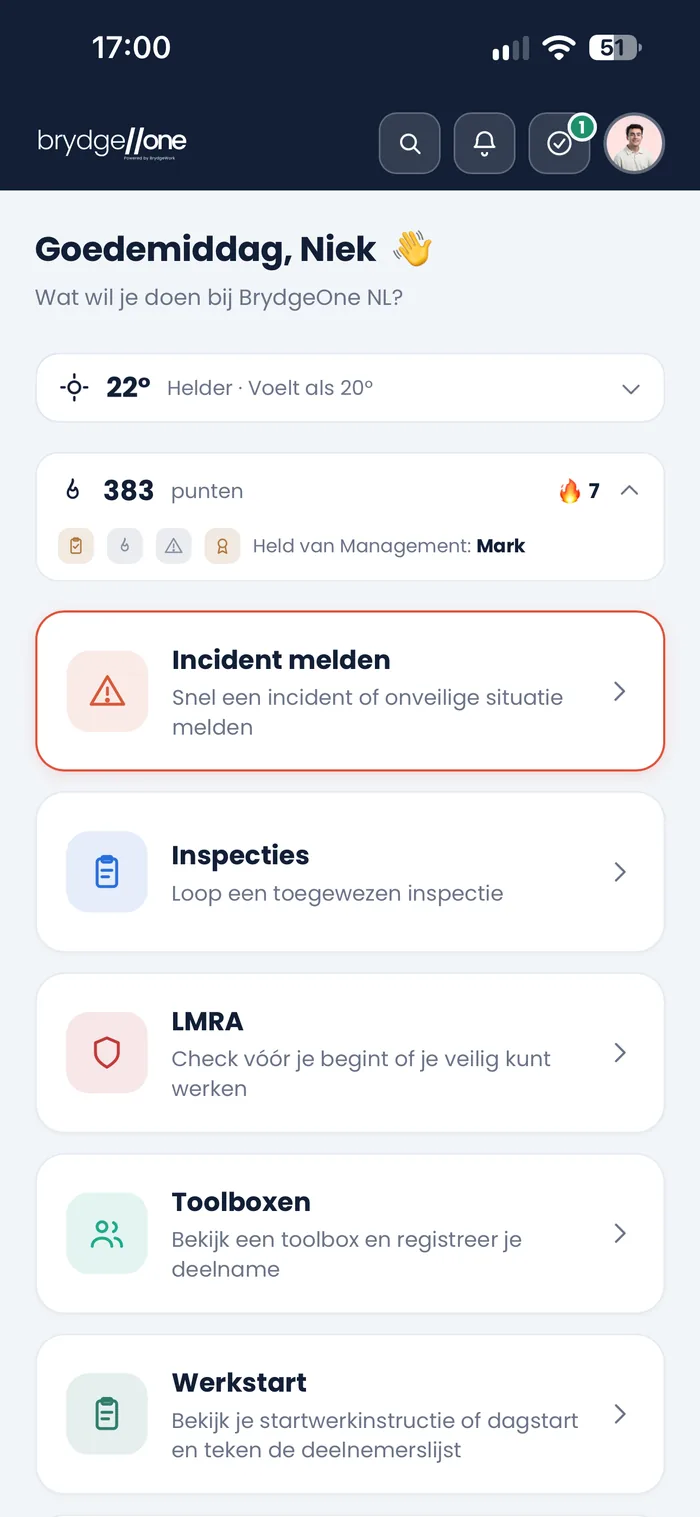 Safety5 min read
What is an LMRA? Last Minute Risk Analysis explained
An LMRA is a short risk check you do right before the work, at the place where you are about to work. You check whether the situation matches what you expected and whether you can start safely. This article explains what an LMRA involves, when to do one and how to record it well.
Read the guide Safety4 min readHow to prepare a risk assessment (RI&E): a step-by-step guide
The RI&E, the Dutch risk inventory and evaluation, is the foundation of your occupational health and safety policy. You map out the risks in your organization and what you do about them. This step-by-step guide helps you build an RI&E that is accurate, usable and kept up to date.
Read the guide Safety4 min readPreparing for VCA certification: a checklist for your organization
Do you want to become VCA certified or keep your certificate? Then you want to know in advance what an auditor looks at and what evidence you need at hand. This checklist helps you approach the preparation in a practical way.
Read the guide Quality4 min readCAPA: how to follow up corrective and preventive actions effectively
CAPA stands for Corrective and Preventive Action. It is how you solve a problem for good and stop it from coming back. This article walks through the route from report to root cause, action and effectiveness check.
Read the guide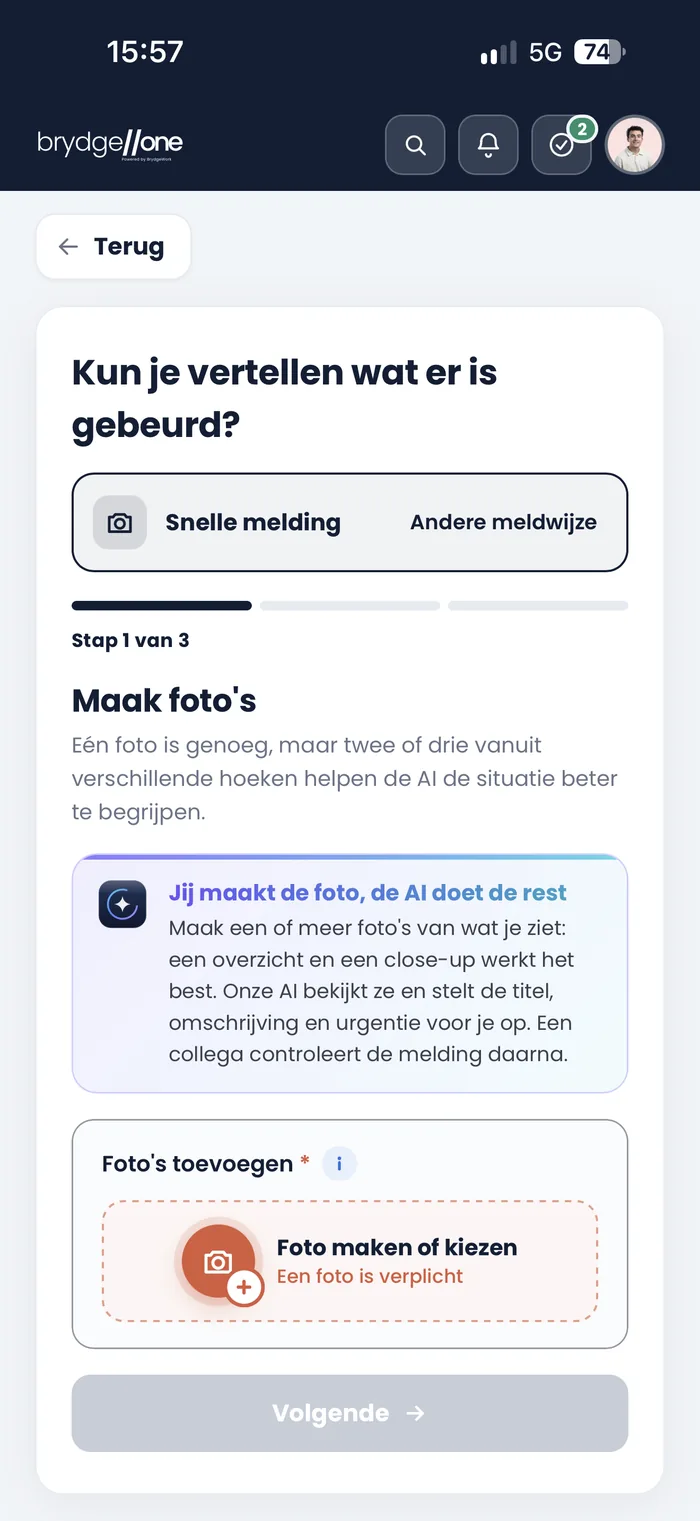 Safety4 min read
Recording and analysing incidents and near misses
Every incident and near miss tells you something about how safe your work really is. You can only learn from it if it is reported, recorded and analysed. This article shows a practical way to do that.
Read the guide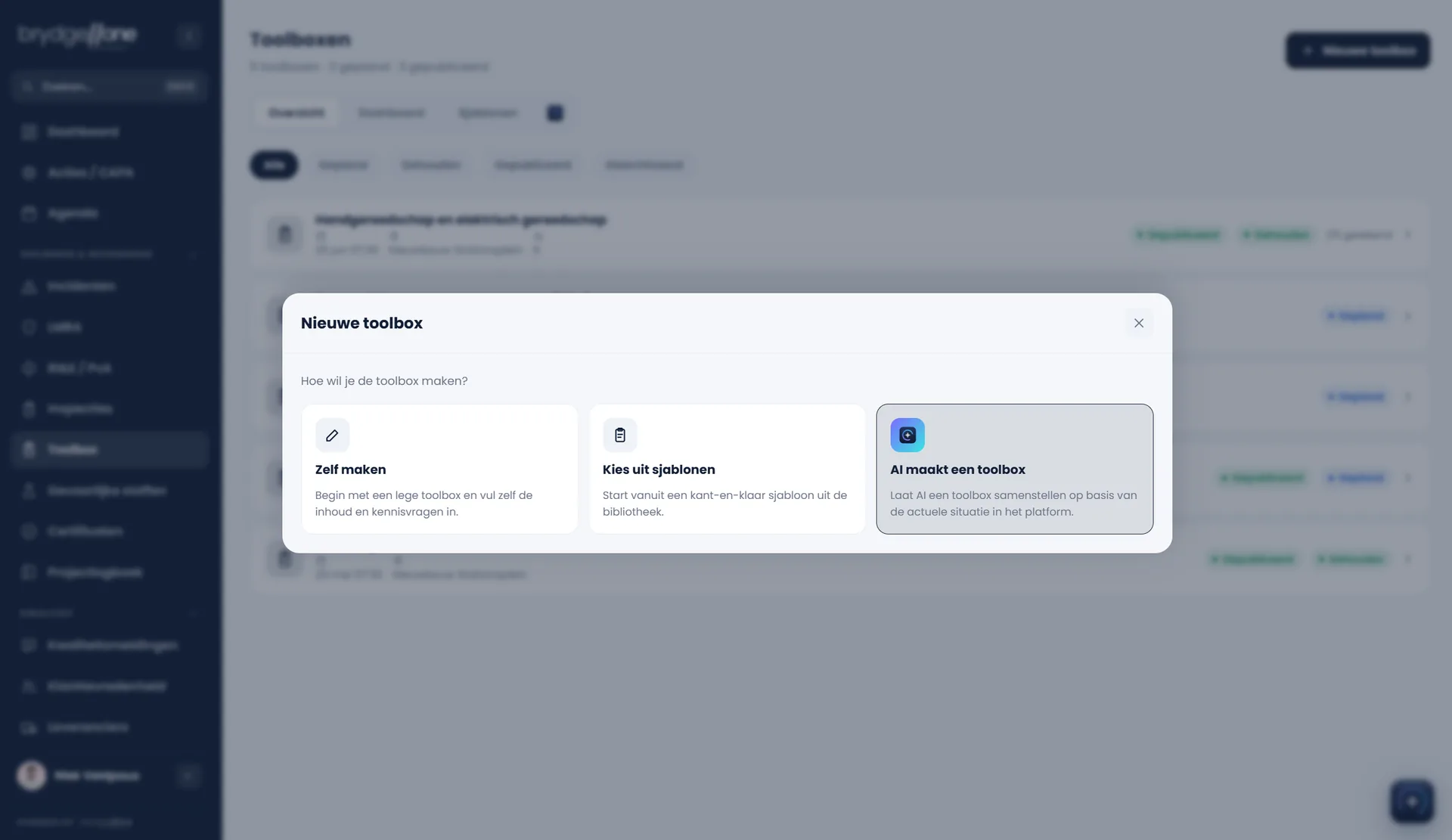 Safety4 min read
Organising a toolbox talk: topics, approach and records
A toolbox talk is a short safety briefing on the work floor or in the workshop. Done well, it brings safe behaviour and attention back into daily practice. Here is how to choose topics, make the session interactive and record attendance.
Read the guide Sustainability4 min readVSME reporting for SMEs: what is it and how do you start?
More and more clients, banks and supply chain partners are asking smaller companies for sustainability information. The VSME standard gives SMEs a clear way to share it. Here is what VSME is and how to get started.
Read the guide Safety6 min readLMRA form: an example with questions you can use right away
An LMRA form is a short checklist that you fill in on the work site itself, just before the work starts. Below is an example with nine questions you can use straight away, with advice on filling it in, what to do after a no, and whether to choose paper or a digital form.
Read the guide Safety6 min readTRA task risk analysis: steps, example and who approves it
A TRA, or task risk analysis, is an analysis of one specific task that you prepare before the work starts. You split the task into steps, look for the hazards per step and choose control measures. Here you read how that works, with a worked example and an answer to the question of who approves a TRA.
Read the guide Safety5 min readApplying for a permit to work: when you need one and how the process runs
Applying for a permit to work means formally asking permission for work with extra risks, such as hot work, work in a confined space or work at height. Here you read when you need a permit, how applying, issuing and closing out work, and which checks belong beforehand.
Read the guide Safety5 min readToolbox topics: ideas by month, season and sector
The best toolbox topics come from your own figures, supplemented with ideas for the season and your sector. Below you find a way to choose, a calendar per month and lists for construction, industry, installation, transport and food processing.
Read the guide Safety5 min readSafety induction for visitors and subcontractors: content, test and validity
A safety induction for visitors and subcontractors is given before anyone may enter your site. You explain the rules and hazards, test whether it has landed and record who has had it. This article also covers the gate instruction, validity and registration.
Read the guide Safety5 min readRI&E example: a worked risk assessment for a small or mid-sized company
An RI&E example shows in a few minutes what ten pages of explanation cannot: how risks, scores and measures fit together. Below we work out a risk inventory and evaluation (RI&E) for a fictional small company that supplies and installs products.
Read the guide Safety5 min readIncident investigation: finding the root cause with the 5 whys method
Incident investigation starts with a simple question: why did this happen? If you keep asking it, you often end up at a cause in how the work is organized rather than at the person who happened to be there. Below you can read how that works in practice.
Read the guide Safety5 min readImproving your reporting culture: how to get more near-miss reports
Near-miss reporting only happens when employees trust that it achieves something and costs them nothing. Below you can read how to find out why reports are missing, what to do about it and how to tell that it works.
Read the guide Safety5 min readWorkplace inspection checklist: what to check and how to follow up
A good workplace inspection checklist makes the difference between really seeing something and just walking a round. Below you can read what to check, how often, who does it and how to follow up findings, with an example checklist per theme.
Read the guide Safety5 min readRegistering and reporting a work accident: what employers need to do
When there is a work accident, you handle reporting and recording on two tracks: you document every accident internally, and for serious accidents you also notify the authorities. Below you can read what you always do, how to investigate and where to check the current reporting rules.
Read the guide Safety6 min readVCA* or VCA**: which certificate fits your company?
VCA* or VCA**: which company certificate suits you depends mostly on how you work and what your clients ask for. You get the difference in plain words, including VCA-P for the petrochemical sector, and a fixed way to make the choice.
Read the guide Management system5 min readSetting up a skills matrix: how to build a training matrix that works
Setting up a skills matrix means defining, per job role, which knowledge, skills and certificates are required, and comparing that with what your people can demonstrably do. That shows you who you can deploy safely where, and where you still need to train.
Read the guide Safety5 min readImproving safety culture: what it is, how to measure it and what works
Improving safety culture only works once you know what it is: the unwritten way people in your organisation think about safety and act on it, even when nobody is watching. You read how to measure it and what helps in practice.
Read the guide Safety5 min readManaging hazardous substances: register, safety data sheets and storage
A hazardous substances register gives you an overview of which products your organisation has, where they are kept and how people work with them safely. Here is how to set it up, from inventory and safety data sheets to storage, instruction and substitution.
Read the guide Quality5 min readWriting an audit report: structure, phrasing findings and an example
Writing an audit report means turning what you saw, heard and checked into a text that others can act on. A good report is short, factual and traceable, and also says what works well. Here is how to structure it and phrase your findings.
Read the guide Quality5 min readHandling complaints: a fixed procedure from receipt to feedback
Handling complaints works better with a fixed procedure than with good intentions alone. When everyone knows what happens after the first report, the customer gets an answer sooner and your organisation learns from every complaint. This is what such a procedure looks like.
Read the guide Quality5 min readMeasuring customer satisfaction: methods, good questions and what to do with the result
Measuring customer satisfaction means asking customers at fixed moments what they think of your work, and doing something with the answer. You can do it with a survey, the NPS question, a conversation or by analysing complaints. Here you read which method fits when and how to ask questions that give usable answers.
Read the guide Quality5 min readEvaluating suppliers: criteria, scoring model and an example scorecard
Evaluating suppliers means establishing, at fixed moments and with fixed criteria, whether a party delivers what you need. What you buy or outsource stays your responsibility towards the customer. Here is how to build an evaluation that stays workable.
Read the guide Quality5 min readDocument control for your management system: versions, approval and review
Document control in a management system ensures that employees always work with the current, approved version. ISO 9001 speaks of documented information and mainly asks for control, not a mountain of paper. Here is how to arrange it practically.
Read the guide Management system5 min readManagement review: example with agenda, inputs and minutes
A management review is the moment when top management checks whether the management system works and where it needs adjusting. Below you will find the inputs, an example agenda and short minutes, so you can build your own version right away.
Read the guide Management system5 min readAnalyzing context and stakeholders: approach with a worked example
The context of the organization consists of the internal and external factors that decide whether your management system achieves its purpose, plus the parties that expect something from you. A clear analysis shows which risks and objectives really matter.
Read the guide Management system5 min readSetting up a risk and opportunity register and keeping it alive
A risk and opportunity register is the list in which you record what can threaten or help your goals, how big that is and who does something about it. Below you read how to set it up, rate entries and stop it from turning into a dead list.
Read the guide Management system5 min readKPIs and objectives for quality, safety and environment: examples
Good KPIs and objectives turn a management system into a steering instrument: you know where you want to go and see in time whether it is working. This guide shows how to formulate an objective and gives examples for quality, safety and environment.
Read the guide Management system5 min readPreparing for a certification audit: checklist for the final weeks and the day itself
Preparing for a certification audit is mostly about making sure you can show what you already do. This guide gives a checklist for the final weeks and audit day, describes what auditors often ask and explains how to handle findings.
Read the guide Management system5 min readManagement of Change: a step-by-step plan for controlled change
Management of change (MoC) is the way you roll out changes to machines, processes, suppliers or organization in a controlled manner, so that an improvement does not become a new hazard. This plan runs from request to evaluation, with examples and pitfalls.
Read the guide Environment5 min readIdentifying environmental aspects: how to inventory and assess them
Identifying environmental aspects starts with a walk through what your organisation does and where it touches the environment. Here you will read how to inventory aspects, assess their significance and attach measures, with example lines for an environmental aspects register.
Read the guide Environment5 min readSetting up a legal and regulatory register: know which obligations apply to you
A legal and regulatory register shows which binding obligations apply to your organisation and whether you comply. Here you will read how to determine what applies to you, how to set up the register and how to keep it up to date.
Read the guide Sustainability5 min readThe CO2 Performance Ladder explained: what it is and how to start
The CO2 Performance Ladder is a scheme with which organisations demonstrate that they map and reduce their CO2 emissions. You mostly come across it in tenders. Here you will read the idea behind it, what you record and how to start.
Read the guide Sustainability5 min readCalculating your CO2 footprint as an SME: scope 1, 2 and 3 step by step
Calculating a CO2 footprint works with data you already have: gas, electricity, fuel and kilometres. Here you will read what scope 1, 2 and 3 are, how to calculate with emission factors and how to record a reduction demonstrably.
Read the guide Food safety6 min readHow to build a HACCP plan: the seven principles in plain language
Building a HACCP plan means deciding in advance where in your process food can become unsafe and how you prevent that. You work with seven principles and a few preparatory steps. Here you read what each step involves and how to approach it in practice.
Read the guide Food safety6 min readAllergen management: building an allergen matrix and preventing cross-contamination
Allergen management makes sure a customer with an allergy never unexpectedly consumes an allergen. That takes an overview of what is in your products, separation in your process and clear information. This is how you approach it, from matrix to training.
Read the guide Food safety5 min readTraceability and recall drills: how to test whether you can really find your product
A recall drill shows whether, when there is a problem, you can quickly find out where a batch came from and where it went. You test your traceability before it is really needed. Here you read how to organize it, run the exercise and record the outcome.
Read the guide Food safety5 min readFood defense and food fraud: the difference, and how to assess them with TACCP and VACCP
Food defense and food fraud are about deliberate threats to food, unlike food safety, which is about unintentional hazards. With TACCP you assess attacks and with VACCP your vulnerability to fraud. Here you read the difference, the approach, example measures and what to document.
Read the guide Safety7 min readIncident report form: an example with all the fields you need
An incident report form records who was involved, what happened, where and when, how serious it was and what was done straight away. Keep the first report short so that people actually fill it in, and add the rest during the assessment. Below is an example with concrete fields, plus what happens after the report and which mistakes to avoid.
Read the guide Safety7 min readHow to make a risk matrix: example with scales, colour zones and worked scores
A risk matrix is a table in which you determine risk as likelihood times effect: you score the likelihood, score the severity of the consequence and read the result in a colour zone. You build one by first defining both scales in concrete terms, then linking a fixed action to each colour and scoring every risk again after the measures. Below you will find the steps, example scales and a worked example.
Read the guide Safety8 min readChoosing RI&E software: what should an RI&E tool be able to do?
Good RI&E software lets you carry out the RI&E digitally and keep it up to date: take inventory per department, assess risks on a fixed scale, follow up measures with an owner and deadline, and have the RI&E reviewed. An RIE tool is more than a form to fill in, because the value lies in follow-up and repetition. Whether your RI&E must be reviewed, and with which instrument you work, depends on your organisation.
Read the guide Management system8 min readWhat does QHSE software cost? Pricing models, extra costs and comparing quotations
The price of QHSE software depends on the pricing model (per user, per module, per site or a fixed package), the number of modules and what is included in the price. There is no fixed market price. Compare quotations on the total cost over three years, including implementation, training and support, and not on the lowest monthly price.
Read the guide Management system8 min readImplementing QHSE software: a step-by-step plan from Excel to a working system
You implement QHSE software in steps: define your goal and scope, appoint an owner, start with one or two modules, set up roles, locations and templates, transfer existing data, run a pilot and then train the office and the shop floor. After a month, measure whether people really use the system, and only then expand. This plan applies to introducing a QHSE platform and to switching from Excel to QHSE software.
Read the guide Safety8 min readISO 45001 or VCA: what is the difference and which one suits your company?
ISO 45001 is a management system standard for occupational health and safety that your whole organisation has certified by a certification body. VCA is a checklist for contractors and other operating companies that want to show clients they work safely, with the levels VCA*, VCA** and VCA petrochemical. In practice your client decides which one you need; the two overlap strongly and you can combine them.
Read the guide Safety8 min readKeeping your BHV organisation up to date: what to arrange, record and practise as an employer
Bedrijfshulpverlening (BHV), the in-company emergency response, is the first line in case of fire, accidents and evacuation. As an employer you organise BHV and appoint one or more BHV responders; how many you need and which training fits depends on your risks, your size and your buildings. Keeping it up to date mainly means knowing who is a responder, until when their training is valid, who is present, when you last practised and what you did with the outcomes.
Read the guide Safety8 min readSafety Culture Ladder explained: the steps, step 3 and how to start
The Safety Culture Ladder (SCL) is an assessment model from NEN that shows how mature an organisation's safety culture is, on five steps from pathological to progressive. A certification body mainly assesses behaviour and culture, through conversations and observations. Clients in construction, infrastructure and rail, among others, sometimes ask for a minimum step in tenders, often step 3.
Read the guide Management system8 min readCarrying out an ISO gap analysis: how to run a baseline assessment for ISO 9001, 14001 or 45001
A gap analysis, also called a baseline assessment, compares for each requirement of a standard what you already have with what is missing, and ends in an action plan with an owner and a deadline. You do it before implementation, shortly before the certification audit and when a new version of the standard appears. This guide covers the steps, an example result and the mistakes that make a baseline assessment useless.
Read the guide Management system8 min readWriting a QHSE policy: an example policy statement for ISO 9001, 14001 and 45001
A QHSE policy is a short statement from management about what the organisation stands for on quality, safety, health and the environment, and what it commits to. It fits on one A4 page, provides the framework for measurable objectives and is known by everyone. Below you read what belongs in it, find an example text of about 120 words and see how to get from policy to objectives.
Read the guide Quality8 min readRegistering and handling a nonconformity: steps and an NCR example
A nonconformity is a situation in which a requirement is not met, such as a specification, a procedure, a legal requirement or a customer agreement. You record it in an NCR (nonconformity report), limit the damage straight away, find the cause, take a corrective action and close it only once the effect has been checked. Below are the steps, the fields of a good NCR form and a worked example.
Read the guide Quality8 min readWriting a process description for ISO 9001: structure, example and common mistakes
A process description records for each process its purpose, its owner, what goes in and out, the steps you take, who does what, the risks and how you measure performance, usually on one or two pages. ISO 9001 asks for a process approach, but does not prescribe a fixed format. This guide shows which processes you have, what to include and what a worked example looks like.
Read the guide Quality8 min readWriting a work instruction: structure, writing rules and a worked example
A work instruction describes step by step how to carry out a task safely and correctly. You write it for the people who do the task, with short sentences, one action per step and photos where possible. This guide shows when you need one, how to structure it, what a worked example looks like and how to make sure employees know it.
Read the guide Management system7 min readHow to make a RACI matrix: example and step-by-step plan for tasks and responsibilities
A RACI matrix is a table that shows, for each task, who carries it out (R), who is accountable (A), who is consulted (C) and who is informed (I). The most important rule is that every task has exactly one accountable person. ISO 9001, ISO 14001 and ISO 45001 ask that responsibilities and authorities are assigned and known, and a RACI matrix is a widely used way to record that.
Read the guide Quality7 min readHow to carry out an FMEA: steps, example and the RPN explained
FMEA (failure mode and effects analysis) is an analysis you carry out in advance: for each process step you determine what can go wrong, what the consequence is and whether you notice it in time. You do it by naming failure modes, effects and causes, scoring severity, occurrence and detection, calculating the risk priority number (RPN) and choosing measures. Below you will find the steps, an example of a process FMEA and the pitfalls of the RPN.
Read the guide Safety8 min readKeeping track of work equipment inspection and maintenance: how to build an inspection register
You keep track of work equipment inspection and maintenance in a register that holds, per item, its identification, location, type of inspection, interval, last and next date, the party who carried it out, the outcome, the certificate and the status. As an employer you decide which equipment has to be inspected, have a competent person do it, and be able to show the written proof at the workplace. Below you can read how to set this up, where intervals come from, what to do after a rejection and what an example register looks like.
Read the guide Quality8 min readManaging calibration of measuring equipment: register, interval and certificates
You manage the calibration of measuring equipment with a register in which every instrument has its own line, with accuracy and tolerance, interval, last and next calibration date, certificate and status. Calibration establishes how much an instrument deviates from a reference, so you know whether you can still trust your measurements. Below you can read which instruments to include, how to set the interval, what to do when an instrument turns out to be out of tolerance and what an example register looks like.
Read the guideNo guide found. Try another search term or look in the glossary.
See how BrydgeOne helps you with this
You only pay for the modules you switch on, from € 49 per month. In a demo we show how it works with your own processes.