
What is an LMRA?
LMRA stands for Last Minute Risk Analysis. It is a short check that the worker carries out personally, immediately before the work starts. The aim is simple: spot anything that has changed compared with the plans and the earlier risk assessment.
On paper everything has been thought through in advance, but on site you only see how things really look right now. Think of scaffolding that has been placed differently, bad weather, a colleague working nearby or tools that are not in order. The LMRA catches those differences.
When is an LMRA done, and by whom?
You do an LMRA every time before you start a task, and again if the situation changes during the work. Many clients and safety systems expect this as standard for project work, maintenance and work on location. Whether an LMRA is mandatory therefore often depends on your client, your safety policy and the work itself.
The worker carrying out the task does the LMRA personally, because that person is exposed to the risk and closest to the situation. If you work in a team, you discuss the outcome together. If in doubt, you consult your supervisor before you start.
The steps of an LMRA
An LMRA does not have to take long. A fixed order helps you avoid skipping anything.
- Look around: what work are you about to do and what does the work area look like?
- Go through the check questions, for example on barriers, tools, PPE, weather and other people nearby.
- Assess each point: is it safe, or is something out of the ordinary?
- Fix deviations on the spot, or stop and consult your supervisor.
- Only start when you are sure it can be done safely, and record the LMRA.
Examples of LMRA questions
The questions depend on the work. An LMRA for working at height looks different from one for work in a production hall. A few examples of questions that often come up:
- Is the work area cordoned off and free of unauthorized people?
- Have machines and tools been checked and are they in good condition?
- Am I wearing the right personal protective equipment?
- Is the ground stable, and are fall hazards and obstacles covered?
- Does the situation differ from the instruction or the risk analysis?
The difference between an LMRA and a TRA
A TRA (task risk analysis) is prepared in advance, at a desk. You break a task into steps, name the hazards, determine the risk and choose control measures. An LMRA is the final check on site: does reality still match that analysis?
The two complement each other. The TRA is the plan, the LMRA is the check just before the start. An LMRA therefore never replaces a TRA for high-risk work.
Recording an LMRA: from paper to digital
An LMRA that has not been recorded cannot be demonstrated later. Paper forms get lost, are not filled in or stay in the van. Recording digitally is faster and provides evidence for audits and clients.
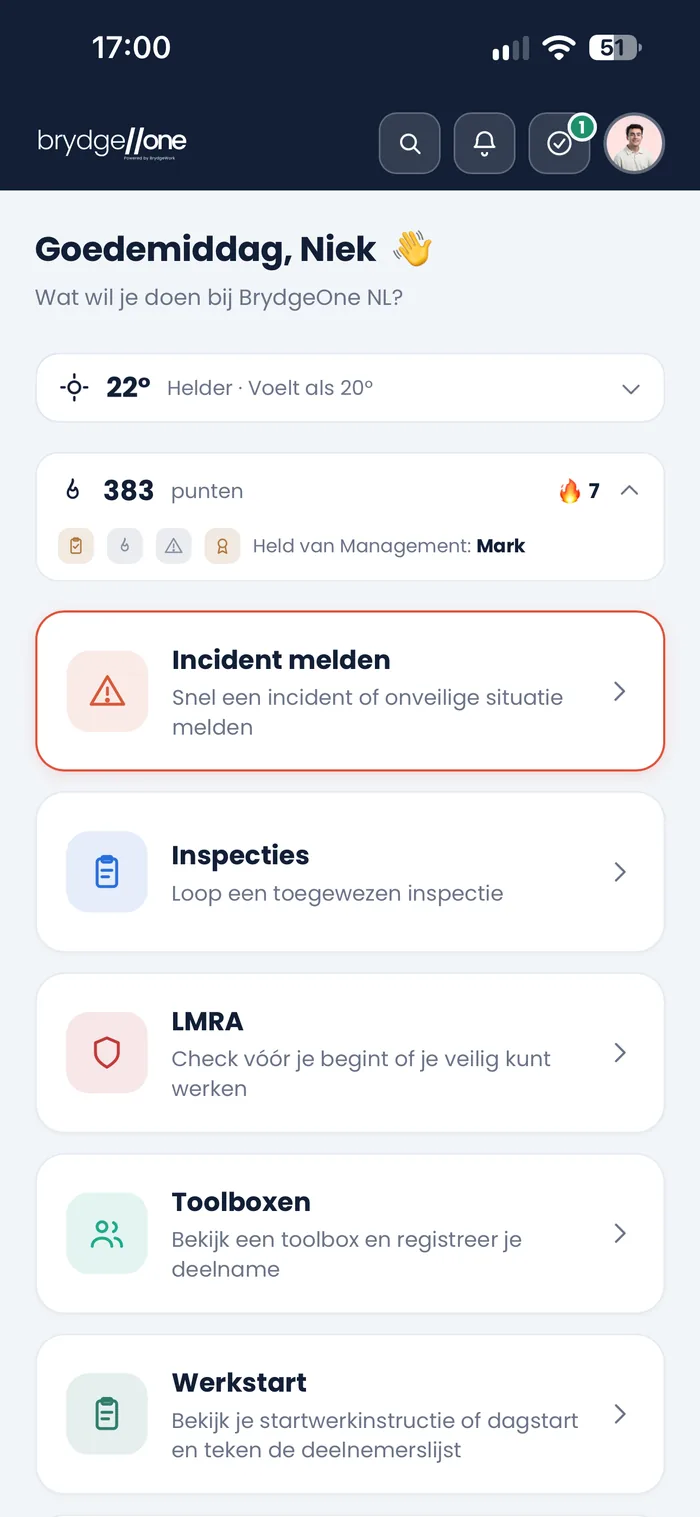
In BrydgeOne, a worker completes the LMRA in the employee app, or via a QR code or link. You set up your own templates per type of work, job role or team. For each question you decide whether yes or no is the safe answer; in the app the chosen answer turns green or red. If an answer deviates, the outcome is that the worker consults first, and follow-up starts.
Common mistakes with the LMRA
The biggest pitfall is that the LMRA turns into a tick-box ritual. Someone answers everything correctly in half a minute without really looking around. You then have a record but no safety. A second common mistake is filling in the LMRA only after the work has started, just to complete the paperwork.
- The questions are too general and do not fit today's work.
- The checklist is too long, so people start ticking instead of looking.
- Deviations are noted, but nothing is done with them.
- No new LMRA is done when the situation changes during the work.
- Supervisors never discuss the outcomes with the team.
How to approach it in practice
Start small and keep it workable. Pick the work with the most risk first and build a template for it with a limited number of clear questions. Let employees help shape the questions, because they know what goes wrong on site. Then briefly explain why the LMRA exists and what you expect from people.
Then look at the follow-up. Discuss deviating answers in a toolbox talk, adjust the template where questions add nothing, and keep track of how many LMRAs are being done. In BrydgeOne you set a target per employee per week or month and see on the Employees tab who is falling behind. With a QR code at the workplace, people without the app can also complete the LMRA.
© 2026 BrydgeOne. General information, not legal or other professional advice. No rights can be derived from this article.